
WHAT THE HOUSE KNOWS
Updated: Sep 24
20 SEPTEMBER - 5 OCTOBER 2026

What the House Knows
A house remembers. It remembers the people who have lived within it, the objects they have kept, the clothes they have worn, the celebrations they have shared and the stories that have travelled from one generation to another. Some memories are visible in patterns and furnishings; others remain in gestures and traditions. These ideas form the foundation of What the House Knows, a group exhibition at Stal Gallery in Muscat bringing together seven artists: Saleem Sakhi, Sarah Al Aulaqi, Hassan Meer, Anwar Sonya, Mohammed Al Zadjali, Wael Hamdan and Hafsa Al Tamimi. The exhibition considers the Omani house not simply as architecture, but as a space of belonging, memory and continuity - one of the first places where identity is encountered and where culture is learned through observation, participation and lived experience.
What the House Knows explores the Omani house as a space of belonging and continuity. What does a house remember? It holds the traces of those who have lived within it: patterns and objects, memories, stories, celebrations and traditions. The house is among the first places where identity is understood, where culture is learned through observation, participation, memory and everyday experience.
The artists approach this idea through different visual languages. Some turn towards the human figure; others explore clothing, ornament, architecture, domestic patterns, childhood and celebration. Together, the works suggest that heritage is not something distant or static. It is something encountered in ordinary life and carried forward through human relationships.
Hassan Meer’s works move through different dimensions of Omani life and human experience, from the symbolic beginning represented in Adam and Eve painting, to the relationship between generations in Father and Son diptych, and towards childhood, imagination and the legends associated with Oman's mountains. “Since my childhood, here in Oman, I have always thought and wondered about the powerful effects these mysterious legends have in controlling and directing the course of man's life,” Hassan Meer says.
Hafsa Al Tamimi turns attention towards motherhood. In her art there is a story of the beginning, the roots that shape us, and the source we always return to. “It is a profound artistic experience that reflects the essential role of mothers in shaping individuals, society, and the homeland that embraces us”, Hafsa Al Tamimi says.
Anwar Sonya brings an Omani wedding to an extraordinary five-metre-wide canvas, 500 × 170 cm, presented for the first time at Stal Gallery. Filled with figures, patterned garments, music and movement, the painting captures the vibrant spirit of the celebration. Look closely and you will notice that this is not the Impressionist Sonya that audiences may know. The figures are constructed through bold geometric shapes and repeated forms, giving the painting a strong Cubist character.
The painting Omani wedding deserves attention because it allows us to see an important artist at a point of change. Sonya has spent much of his career developing a highly recognisable Impressionist style. Here, he presents an Omani wedding as a stylised Figurative painting with a strong Cubist influence. The movement from his established Impressionist language towards Cubism makes this work especially rare and significant within his artistic development.
For Saleem Sakhi, traditional dress becomes a language through which identity can be seen. His portraits foreground the distinctive forms, colours and patterns of Omani clothing, from the kumma and dishdasha to the richly patterned garments worn by Omani women. A garment can identify a place, an occasion or a tradition.
Sarah Al Aulaqi similarly looks at the relationship between material culture and identity through Dhofari traditional cloth, head jewelry and burqa, alongside the enduring practice of Omani tailoring. Her work draws attention to the knowledge embedded in textiles and adornment. Their significance lies not only in their visual beauty but also in the practices, craftsmanship and cultural knowledge they carry.
Mohammed Al Zadjali finds another vocabulary of continuity in traditional Omani patterns. Drawing inspiration from motifs found in house interiors, he explores pattern as both visual language and cultural memory. Repetition becomes significant: a form can return again and again, across surfaces and generations, while still being interpreted in new ways.
For Wael Hamdan, the architectural character of Oman provides another way of considering belonging. His Domes of the City art collection presents enduring architectural spaces connected to the experience of place and home. Architecture can outlast individual lives. Yet a building acquires meaning through the people who inhabit it. Its walls become witnesses to daily routines, gatherings, departures and returns. This is perhaps where the title What the House Knows becomes most resonant. The house is silent, but it is never empty of meaning.
The exhibition ultimately asks a question larger than heritage: what does a house know? The deepest values represented in the exhibition are identity, belonging and continuity. To appreciate them is to listen to older generations, to allow younger generations to understand where they come from, and to recognise that cultural knowledge becomes fragile when it is no longer practised or remembered.
The exhibition therefore leaves its visitors with a personal questions. What does your house know? What stories are held within it? Which objects carry memories? Which traditions have quietly shaped who you are? And what will remain when your generation is no longer there to tell the story? The seven artists offer no single answer. Instead, through different approaches to figure, colour, pattern, textile, architecture and memory, they create a visual conversation about what it means to belong.
The gallery will also offer free guided educational tours throughout the exhibition, led by Volodymyra Sobolevska of stal Gallery, introducing visitors, students and researchers to the artistic techniques, creative processes and stories behind the artworks.

Opening exhibition
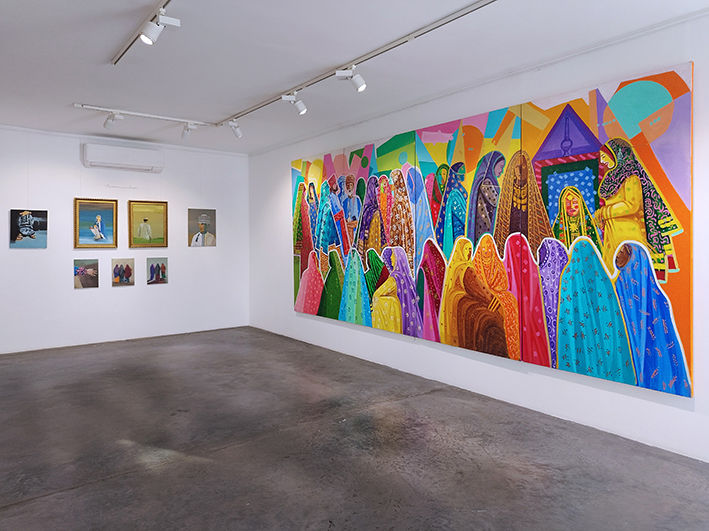
Omani Wedding, 2026 by Anwar Sonya

Mother series of paintings, 2020-2023 by Hafsa Al Tamimi

Adam and eve, 2012 by Hassan Meer

Series of paintings about family and home, 2013 by Saleem Sakhi

Domed houses 2026 by Wael Hamdan

Omani fabrics art installation, 2026 by Sarah Al Aulaqi

Omani patterns series of paintings 2026, by Mohammed Al Zadjali
© Stal Gallery and Studio
Supported by: Alserkal Group


Comments